

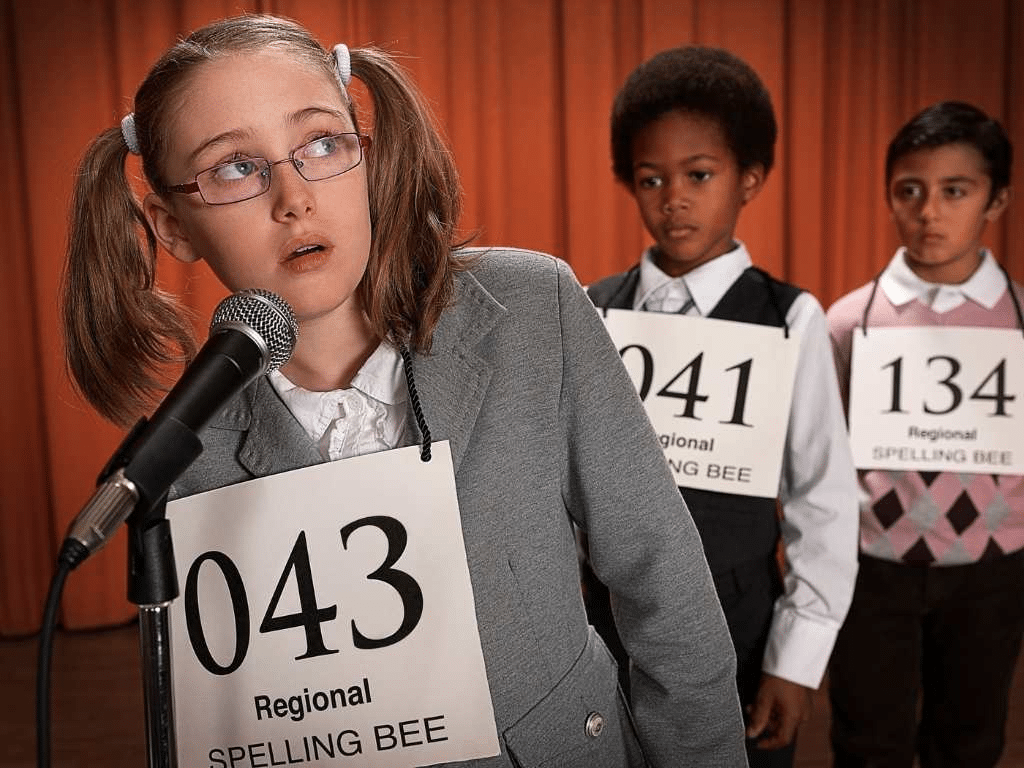
Ever pause mid-email to ask, “Wait… is it ‘recommendation' or ‘reccomendation?'”
You’ve read that word a thousand times without blinking—but when it’s your turn to produce it, your fingers hesitate, your brain second-guesses, and autocorrect quietly rolls its eyes.
That little stumble isn’t a flaw in you—it’s a clue about how literacy develops.
For almost everyone, reading comes first, and spelling follows behind.
We can recognize long, morphologically complex words like:
recommendation, accommodate, musician, or unintelligible years—even decades—before we can reliably spell every letter.
Why?
Because recognizing a word can succeed with partial information and meaning.
Spelling demands the exact sequence of graphemes, including the tricky bits English preserves for meaning (recommend → recommendation), history, or position.
In this post, we’ll:
👉 unpack why that lag is normal (we should expect it),
👉 show charts that map typical “read by” vs. “spell by” ranges, and
👉 share short, high-leverage routines that help spelling stay afloat—without slowing reading.
Let’s turn those “Is it two m’s or two c’s?” moments into confident teaching moves.
(BTW, recommendation is the correct spelling. 😅)
Why Kids Read Words Before They Can Spell Them

Recognition Is Easier Than Recall
When we read a word, we rely on recognition.
When we spell a word, we have to rely on recall.
And recall is much more challenging.
Think of it like this:
- Reading is like a multiple-choice test—you can often make a good guess with partial information.
- Spelling is like a fill-in-the-blank test—you need to know the exact answer, without any clues.
Reading doesn’t always require perfect information. We can usually figure out a word with:
- Most of the letters
- A bit of context
- Or just enough familiarity to recognize it automatically
Take the word “desperate,” for example.
You might read it easily because it’s been orthographically mapped (your brain knows what it looks like).
But when you go to spell it?
You might pause. Was it “-ate,” “-et,” or *“-ite”? 🤔
That’s the difference.
Spelling demands more.
It requires the exact sequence of graphemes—no shortcuts. That’s why it’s a higher bar for the brain.
In fact, once you can spell a word, it usually means you have a deeper, more durable understanding of it.
Reading is Many-to-One, Spelling is One-to-Many
When we read, we go from print to sound.
That is, the system is mostly many-to-one: a given grapheme (or spelling combination) usually maps to one common sound in most contexts.
For example, “sh” → /sh/ in ship, wish, shelter.
Even flexible teams like ea often default to one or three high-probability sounds (/ē/ in eat, /ay/ in steak or /ĕ/ in bread).
That means readers can succeed with knowledge of a few strong regularities.
In contrast, when we spell, we must go from sound to print—and the system flips to one-to-many: a single phoneme may have multiple plausible spellings, and you have to choose the right one for the word, position, and morphology.
➡️ Is the /ee/ sound in “believe” the “ie” spelling or the “ei” spelling?
➡️Does “accommodate” have two C’s… or just one? (Asking for every teacher ever 🥹.)
Why does spelling slow us down?
Spelling is harder than reading—partly because of all the branching in our sound-to-spelling system.
Readers can “get close” and still succeed.
Let’s say a child sees the word “cake.”
Even if they think the /ā/ sound should be spelled “ai,” they might still read the word correctly because:
- The context helps
- Their brain fills in the rest
- They’ve seen enough similar /ā/ patterns to figure it out
Spellers don’t get that luxury.
Now flip the task.
That same child hears /ā/ and has to choose between:
- ai (rain)
- ay (day)
- a_e (cake)
- ea (great)…and more.
But they haven’t fully internalized those spelling patterns yet—especially the ones based on position or morphology.
So what should you do?
Let’s say you just taught a phonics pattern, and your student can read words with it…
…but can’t spell them yet.
✅ That’s OK. 👉 You may still be ready to move on to the next decoding goal.
Don’t let spelling hold back a reader who’s actually decoding well.
Their brain just needs more time—and more exposure—for the spelling to catch up.
The big idea:
Get the reading to stick first.
With wide reading, writing, and practice…
The spelling will come.
English Spellings Preserve Meaning, Not Just Sounds
English spellings represent both:
✔️ Sounds (phonemes)
✔️ Meaning units (morphemes)
That’s why we keep the c in muscle → muscular and the n in hymn → hymnal—even when those sounds disappear in speech.
Some morphemes carry a consistent meaning across many words—no matter how they sound.
You’ll see them in endings like:
- -ed
- -s / -es
- -er / -est
- -tion / -sion
And in prefixes like:
- re-
- un-
- dis-
We keep their spelling the same—even when pronunciation shifts.
Example: Photograph → Photography
The stress changes, but the spelling of photo stays the same. Why? Because the meaning stays the same.
This meaning-first stability is actually a gift.
It helps students:
✅ Recognize word families
✅ Grow their vocabulary faster
✅ Read new words with more ease
But… it does add complexity to spelling.
Students have to juggle sound–letter links and morphological consistency.
Bottom line:
Students will often read complex patterns before they can spell them correctly.
That is a normal developmental sequence to expect—not a gap to panic about.For a deeper dive on how reading practice fuels writing growth (and vice versa), see our overview of the reading–writing connection.
What Research Shows About the Reading—Spelling Gap
What Standardized Tests Reveal About Reading vs. Spelling
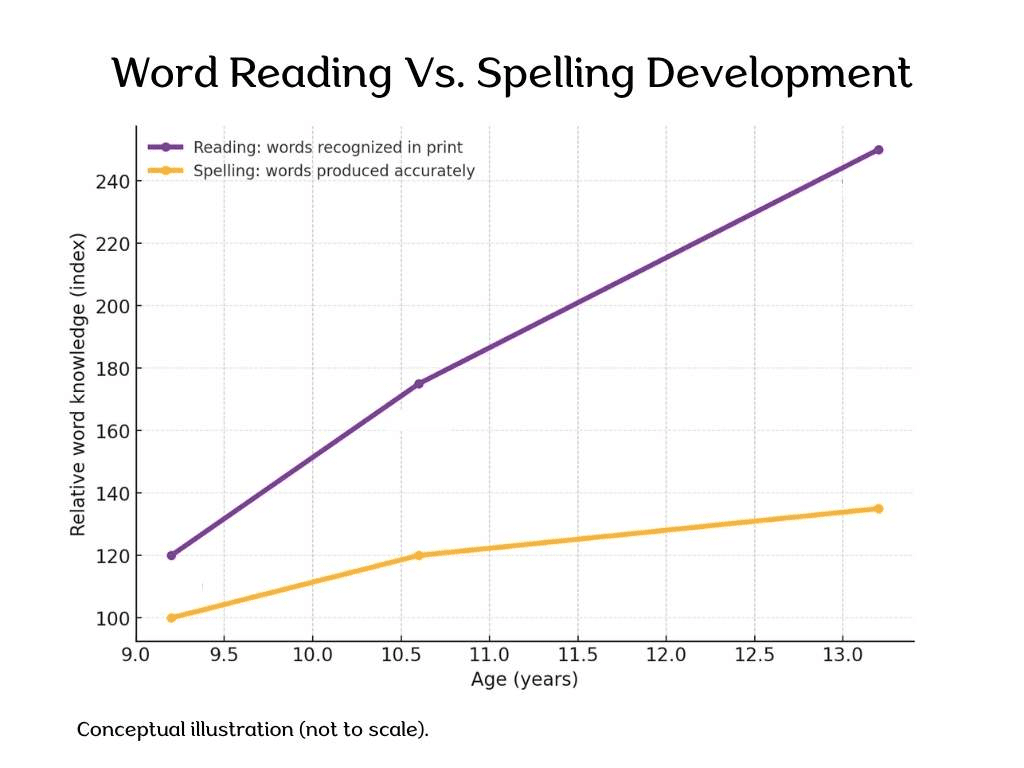
Recently, researchers examined the discrepancy between the difficulty of words on reading standardized tests and that of standardized spelling tests.
They identified the likely last word that the average reader might read correctly from a list of words and contrasted it with the last word that the average speller of the same age group might be able to spell.
Why Spelling Tests Use Easier Words Than Reading Tests
In these standardized tests, words that students can typically spell are much more common than words they can read.
A significant gap exists between the number of words that can be read as compared to those that can be spelled for kids under 3rd grade, and it increases in size as students mature.
See the chart above to visualize the following data:
- At 9.2 years, spelling-test words are about 6× more common in print than reading-test words.
- At 10.6 years, about 12× more common.
- At 13.2 years, about 31–32× more common.
In other words, students are able to read many many more unusual words as compared to the words that they can spell. So, if a student just learned to read a word but can’t spell it yet, that’s normal—and expected.
Tests reflect this reality by using harder words for reading than for spelling, especially as kids get older.
What 1st-3rd Grade Spelling Expectations Really Look Like
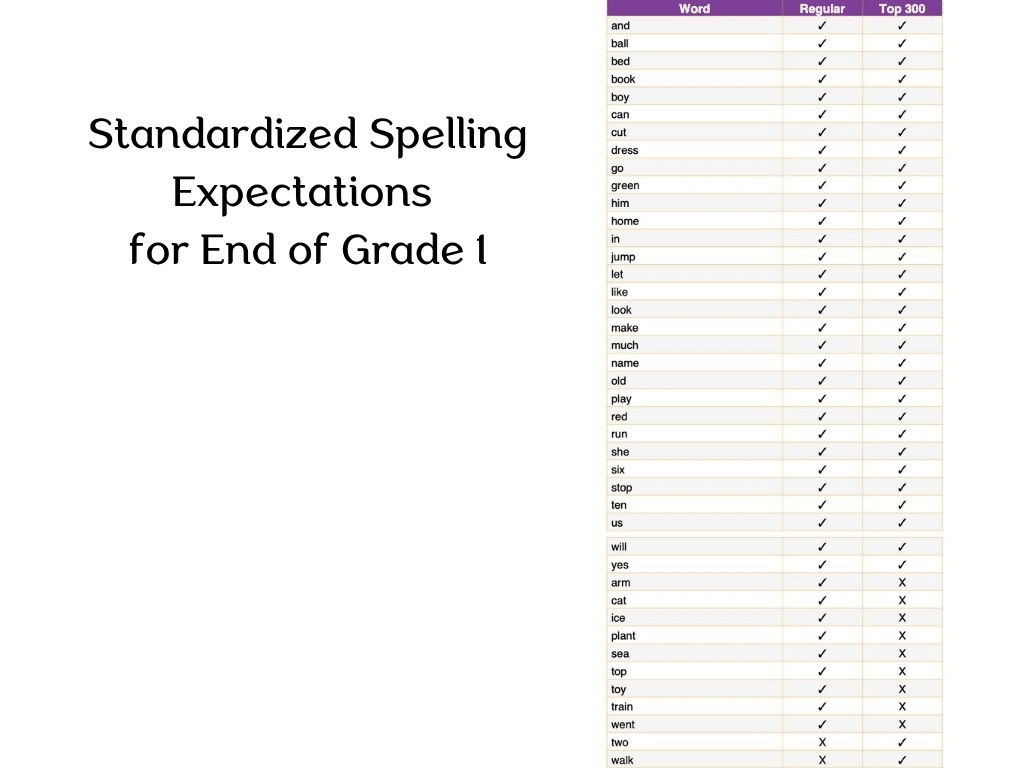
While we may teach many advanced phonics patterns and less frequent spellings for first grade reading instruction, national standards do NOT expect that all of that information will be transferred to spelling.
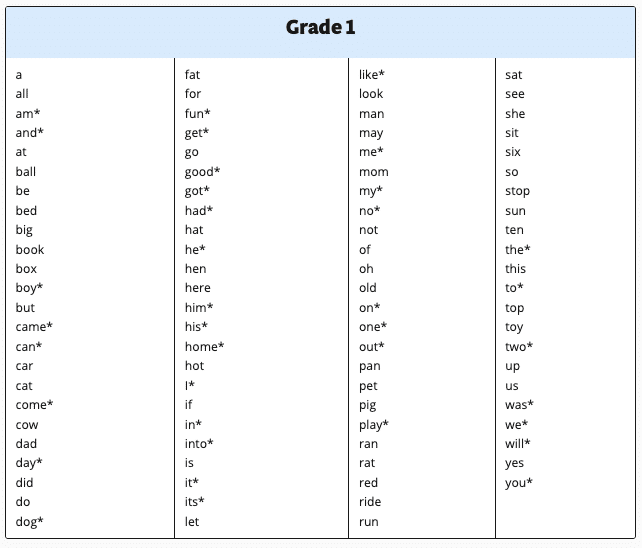
For instance, I gathered words from 3 norm-referenced spelling tests that an average end of 1st grade speller would know.
95% of the words in this list are highly regular.
We’re talking words like:
“and,” “bed,” “can,” “cut,” “home,” “like,” “look,” “name,” “play”. (See chart above.)
But here’s the kicker:
Even students who’re reading and spelling well at the end of 1st grade simply haven’t had enough exposure to less regular words like “again,” or “enough” to spell them consistently yet.
And that’s totally developmentally appropriate.
What else shows up in early spelling expectations?
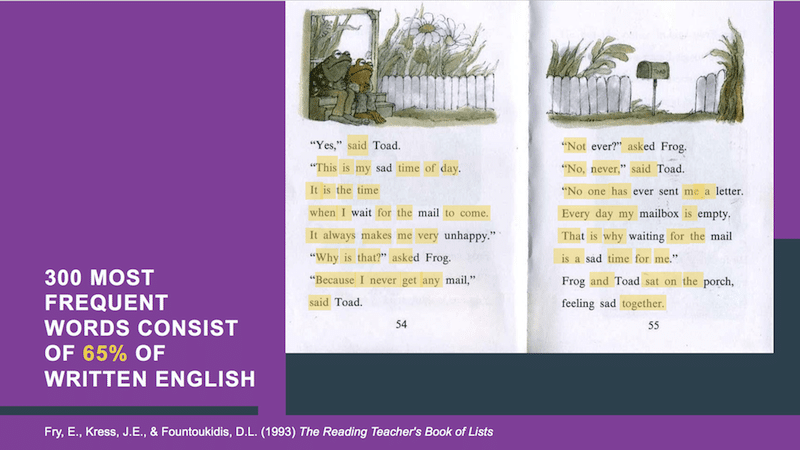
About 80% of the words expected to be spelled at the end of 1st grade come from the Top 300 Fry word list.
And that list is no joke—it makes up over 65% of written English. So few words carry so much weight!
These high-frequency words are also the key to unlocking early texts like:
See the Frog and Toad excerpt below—the Top 300 words are highlighted, and as you’ll see…
They’re nearly the entire text.
Many a 1st grade reader will be able to read words outside the Top 300 Fry word list, like:
“plane,” or “stood,” or “fact.”
But…most good 1st grade spellers will not be able to spell them.
So, what’s the best way to check for learning?
👉 Have them read a list of long “a” words or read the words in a connected text.
Not a spelling test.
The spelling test is a fine quiz to teach students to attend to spellings, but it's not a marker of reading attainment.
Why?
Because spelling development almost always lags behind reading. It follows along—but it’s slower to stick.
Dr. Katie Pace Miles confirms this, too.
She discusses the “spelling trails reading” pattern in this video around minute 51:00–52:00 in the video below.
So what helps spelling catch up?
1️⃣ Opportunities to analyze words for orthographic mapping—
This helps students lock in the spelling after decoding.
2️⃣ Plenty of reading and re-reading
This gives them time to see and use the phonics patterns you’ve already taught.
And when you do give spelling assessments…
Keep in mind what’s fair and developmentally appropriate.
We can only expect accuracy with:
- Highly regular words
- Highly frequency words (think: Top 300–500)
For example:
🟡 “Boil” isn’t even in the Top 1000 most frequent words.
So it’s not realistic to expect a typical 2nd grader to spell it correctly.
🟡 Likewise, if a 1st grade spelling test includes “stuff” or “fuzz” (nowhere near the Top 1000)…
…it’s asking way more than what’s developmentally typical—
even compared to nationally normed spelling tests.
Bottom line:
Let reading lead… and spelling will catch up with time, practice, and exposure.
What This Means for Your Reading Instruction
This difference between what students can read and what they can spell isn’t just interesting—it should directly shape how we teach.
Writing experts Steve Graham, Karen Harris, and colleagues created the Basic Spelling Vocabulary List, which is available here: a handy reference when wondering what is realistic for each grade level.
You'll notice the words they chose are tightly connected to high-frequency words.
The well-known LETRS program also makes a clear distinction between what to expect for reading vs. spelling.
For example:
- Final consonant blends like “nd” or “nk” aren’t expected to be mastered in spelling until grades 2–3.
- That means it’s perfectly normal for a 1st grader to read the word “stand”… but not be able to spell it yet.
So what should you be using to measure progress?
Monitor progress with reading tests—not spelling tests.
Don't Hold Readers Back Because of Their Spelling
If you just taught the long “o” sound and its various spellings, the primary diagnostic question isn’t:
“Can they spell ‘oa’words yet?”
It’s:
“Can they read them?”
If we wait for spelling to catch up before moving on, we risk stunting reading growth.
Reading is the lead racehorse—it naturally dashes ahead of spelling skills.
So how do students eventually learn to spell those words?
- By reading them over and over.
- Then, by trying to spell them, making mistakes, getting feedback, and trying again.
That’s the process.
So, yes, your 1st grader may be able to read an unusually spelled word like “people.” Great! But don't expect her to learn to spell it until grade 2.
Similarly, your 2nd grader may be able to read the word “friend,” but don't expect him to be able to spell it until grade 4. Sure, coach him on that tricky “ie” in “friend” when he misspells it in his writing.
But don't be surprised if he still misspells it tomorrow.
And don't hold up reading instruction, so you can spend several days on teaching the spelling of “friend.”
Reading Goals First, Spelling Goals Later
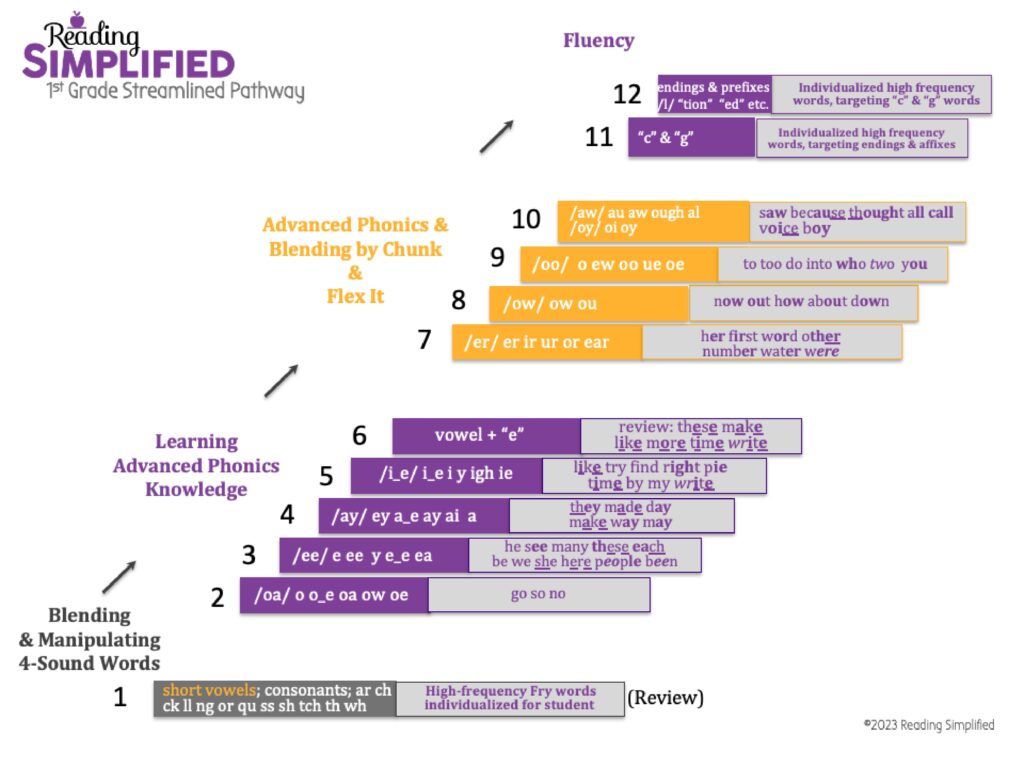
In Reading Simplified, our reading goal leads, and our spelling goals follow along later.
While we use spelling activities in every Word Work game, we’re leaning on spelling's analytical help to:
- support readers attacking unknown words, and
- provide the opportunity for a decoded word to “stick” or to become “orthographically mapped.“
This is a key difference tutors and teachers notice between Reading Simplified and other programs:
➡️ Most other approaches expect students to master spelling and reading at the same time—which often stalls reading progress.
Why prioritize reading first?
As we discussed earlier…
Reading can succeed with partial recognition + context clues.
Spelling demands recall, precision, and navigating trickier one-sound-to-many spelling choices.
But here’s the magic:
When students meet the same words again and again in connected text, the spelling begins to stick—with far less effort.
So when you prioritize reading growth first,
you multiply exposures —and that’s the fastest route to strong spelling later.
Many Simplifiers go through our one-page scope and sequence, aka the Streamlined Pathway (pictured above), one time through with reading goals as the focus.
Once students are fluent—or nearly fluent—that’s the perfect time to loop back through the Pathway with a spelling lens.
Same activities. Two instructional purposes.
The activities don’t change…
But when you shift your focus to spelling, you might slow down a bit—pausing more often to help students analyze specific words.
That’s totally normal.
In fact, here at Reading Simplified, we’re often victims of our own accelerated success. 😅
Our approach releases phonics knowledge faster than most mainstream phonics programs.
So students begin reading words with advanced phonics patterns—like /oa/—much earlier.
Think of words like:
boat, go, show, home, toe
We regularly see kindergarten or early 1st graders reading word like these with confidence.
And it’s thrilling to watch!
Some of them are even jumping into early chapter books like Frog and Toad!
But then something happens…
A child sits down to write the word “boat” and freezes.
Or they pick the wrong spelling for the /oa/sound.
Then you panic thinking, “Wait! I thought she knew this!”
Here’s the truth: She probably does.
But, not to beat a dead horse, this is simply the natural order of things.
Recognizing the word “boat” in a story is much easier than writing the word “boat” from memory. How can she be expected to spell “boat” if she has only seen the word 2 times in her entire life?
Let’s make it real…
How well would you spell these right now?
- recommendation
- elaborate
- committee
- stationery (or is it stationary?)
You’ve gotta admit that just a couple of exposures of reading those words did not translate into your spelling ability, right?
And it’s the same with our students.
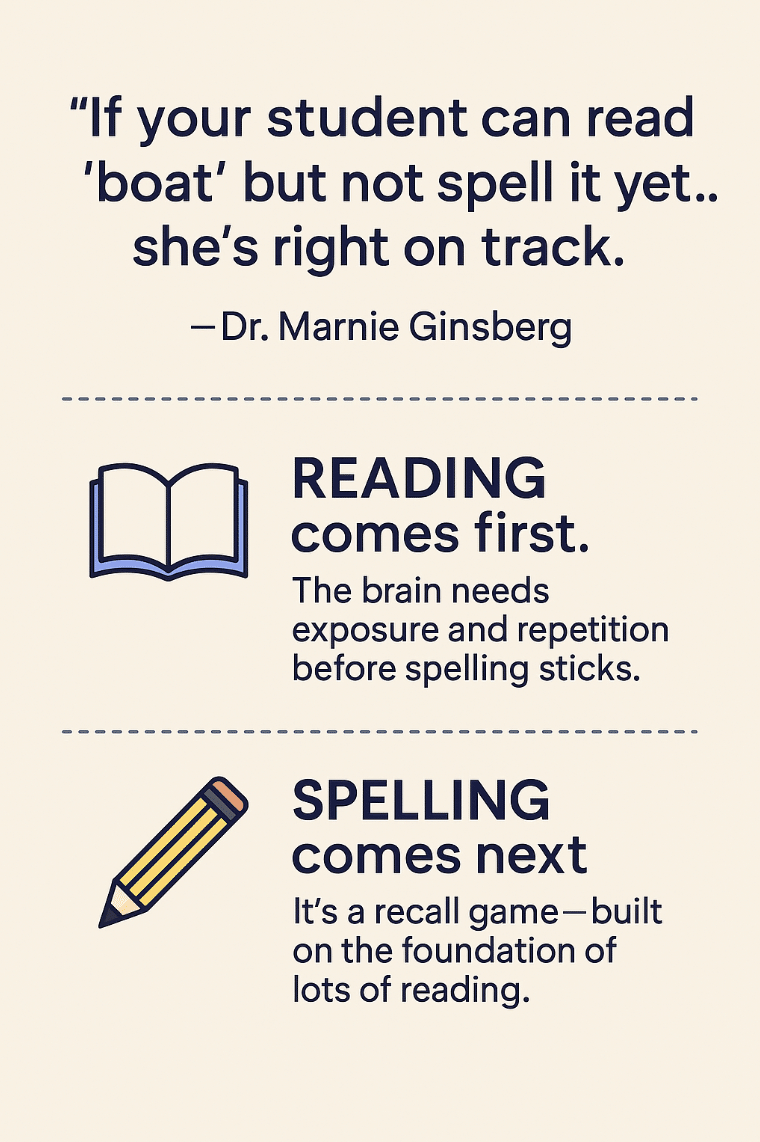
- Reading first.
- Spelling is a tool to help reading.
- Spelling goals later.
- Dictation (or Write It) is still your strongest spelling activity.
How Orthographic Mapping Connects Reading and Spelling
Again, kids almost always read a word before they can spell it.
That’s not a problem—it’s the natural order of things.
Reading can succeed with fuzzy memory and meaning support, while spelling demands exact letter choices in the right order.
The bridge between the two is orthographic mapping—the process by which a newly decoded word becomes stored in long-term memory so it can be recognized by sight.
Orthographic mapping depends on opportunities for students to:
- analyze the sounds in words,
- connect those sounds to specific graphemes (letters or letter teams),
- meet the same words again and again in connected text.
So instead of stopping reading instruction until spelling “catches up,” we keep reading in the lead and use short, smart spelling practice to strengthen those mappings—especially for high-frequency patterns and words.
Quick Checklist for Supporting Spelling the Smart Way
Here's what to do if you're concerned about spelling:
- Teach your student(s) to read very well.
- Help them to read widely so they meet important words many times.
- Coach them to Write & Say words that they miss in their writing.
- Bundle these words with common patterns to help them see the relationships.
- Keep giving them more chances to read those same patterns in books and texts.
Bottom line: Don’t hold readers back for spelling. Let reading growth lead, then use spelling as a powerful tool to lock in what they’ve already encountered in print.
Your Turn!
How and When Do You Support Your Students' Spelling?
We'd love to hear from you in the comments below:

My school uses the LETRS spelling screener and a spelling based mastery test for the end of our phonics unit. I have felt that these tests are not showing us the right data. This article confirms this! Thanks!
Right. Spelling assessment can be very powerful but it can also be easily misunderstood, especially if it’s not norm-referenced.
This is an enlightening and encouraging post. I work with small reading groups from kindergarten through sixth grade. We are using the University of Florida Literacy Institute’s (UFLI) Foundations program. At the end of each lesson we check our students’ learning progress with a reading passage and a spelling test focused on the phonics skills they’ve been practicing. Our spelling tests includes Elkonin boxes for the first three words. I find this frustrating, especially when we test words that end in “ng” or have silent letters. Most of the older kids can ace the reading tests, then score much lower on spelling. Now I know that is totally normal! I will no longer hold up reading instruction for lack of spelling proficiency. Thank you!
Love your conclusion Dyanna!! Thanks for your kind words.
I have retired but found myself reading this interesting article. 🙂 Thank you for the excellent information. I used Reading Simplified when I taught and found it the excellent choice to help struggling readers. Keep up the great work!
Delighted to hear from you Sherry!! Much appreciated. 🙂
Excellent article. I have just started w 2 new students. One came because the main concern is spelling. The other was just questioning spelling last session. So timely!
Perfect! Thanks Angela.
I TOTALLY get this: spelling development follows reading development.
So … what does it mean when measurable spelling development (developmental spelling inventory and spelling analysis) seems to be progressing in front of measurable reading progress (nonsense word reading sand oral reading passage scores)? I have a couple of kiddos in my caseload like this.
It is generally an unexpected profile except for the earliest readers. But I have seen it too. I wonder what age and reading level these students are?
The spelling task is heavy on segmentation and phonics knowledge. The reading tasks, in contrast, are heavy on blending and phonics knowledge, as well as flexible decoding–for the real words. Could those that fit this profile benefit from more coaching in continuous blending and reading and re-reading of real texts, with feedback?
Thank you Dr.Marnie for once again an excellent article. It really did clear up the mystery of the spelling lag with CVCC and some CVC words my K and First grade students are able to read but get stuck writing. Plus K students sometimes have to think also how letters are correctly written! Also thanks for the free appropriate grade level spelling lists!
Glad it was helpful!! Yes, CVCC is harder phonologically than CVC so there would be a period in K where there is even a gap between those 2 levels. However, given the predictability of most single-syllable short vowel words, we would expect most of our K students to spell both CVCC and CVC words correctly…even if they haven’t seen them before.
Great point about handwriting. Transcription can be a drag on processing at this developmental level.