


We’ve got a phonics /ay/ sound story for Valentine’s Day, and we can't wait for you and your students to dive in!
You’ll use this Valentine's story along with our Sort It activity to pack a lot of lovely code learning into a reading session!
The Sort It activity is an innovative and effective way to boost your students' phonics skills since it packs in several skills at once.
This activity is designed to help students recognize and remember different spellings for a given sound, particularly focusing on the /ay/ sound for this lesson.
By coupling the cute story with the Sort It activity, students not only practice reading, phonics, and phonemic awareness, they also may have an opportunity to summarize the gist of a simple plot line.
PLUS…we have 3 different levels of this story for you: K, 1st grade, and 2nd grade reading levels. Meet each of your readers' needs with this gift from us!
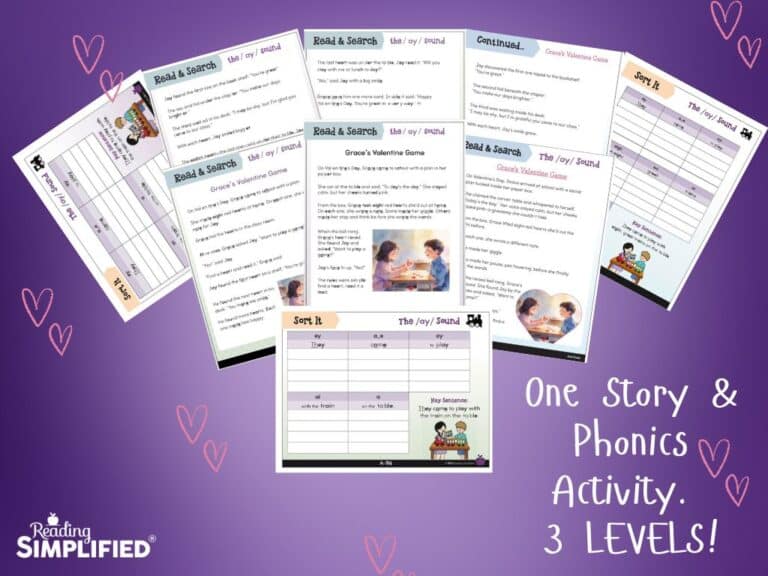
Valentine’s Day Phonics Activity for the /ay/ Sound
Here are the simple steps we recommend for this Valentine's Day activity:
- Introduce the /ay/ sound and the Key Sentence (just briefly).
- Ask students to read the story focusing on the /ay/ sound.
- Ask them to summarize it afterward.
- Re-read it to them slowly so they can follow along. If time allows, ask them to re-read once or twice.
- Have students Search for the /ay/ Sound words and draw a heart around the /ay/ spellings (not the whole word, so they focus on the target spellings).
- Either as they find them, or afterwards, have them Write and Say the /ay/ words in the appropriate column.
Some words may include phonics patterns that you haven't taught yet. That's ok because Share's self teaching theory reminds us that we simply need to give explicit instruction to develop:
- sufficient phonemic awareness,
- phonics knowledge, and
- decoding strategies…
…the child's self-teaching abilities will help gather up the rest of the minutia of our code!) Of course, if they can't figure out a word for themselves, simply give them a tip that will help them.
Sort It is an organizational strategy in the Reading Simplified system for teaching and learning more advanced phonics information.
Through Sort It, students analyze words through reading, sorting, and saying sounds as they write (spelling) and build a better understanding of how our written code works and the two principles of Linguistic Phonics, or Speech-to-Print, approaches:
- Sounds can be represented by one or more letters, and
- Sounds can be spelled in different ways (e.g., “a,” “ay,” “ai,” “a_e,” “eigh,” etc).
Similarly, and more importantly, grouping by sounds helps the student more rapidly memorize the variations in the spellings of each sound.
Through the two techniques utilized in Sort It, that of a graphic organizer and the Key Sentence mnemonic, the new or struggling learner is given a mental filing and retrieval system that tends to facilitate faster learning of phonics knowledge.
For instance, in one lesson, we introduce the /er/ and its major spellings (i.e., “er,” “ir,” “ur,” “or,” “ear,” and “ar”). Students spend all week reviewing the Key Sentence and doing reading, re-reading, and Word Work activities to develop transfer of these spellings to more and more unknown words that they will encounter in the future.
Thus, we systematically and explicitly guide students to learn most of the code, especially the most frequent spellings.
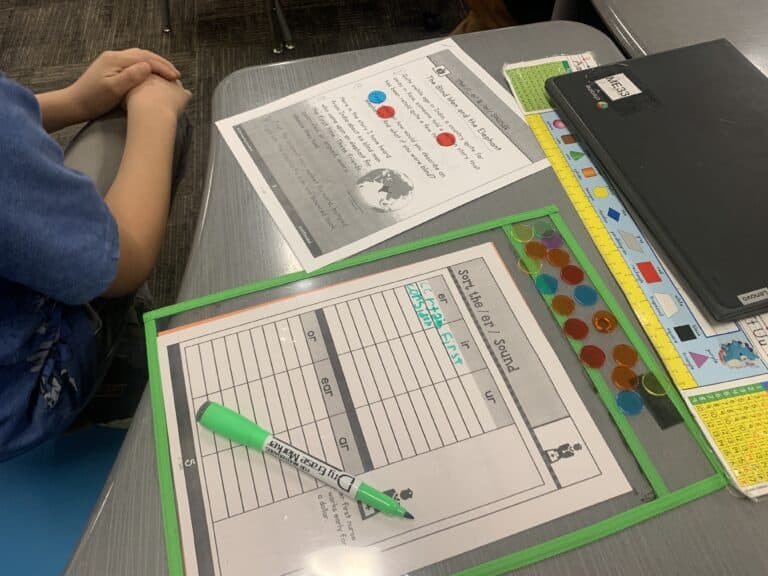
Like all of our key strategies in the Reading Simplified system, Sort It integrates multiple subskills:
- understanding of how our code words,
- phonemic blending and segmenting,
- advanced phonics knowledge,
- decoding of unfamiliar words, and
- high-frequency word knowledge.
Grouping by sounds also helps the teacher wrap her head around the otherwise all-too-daunting phonics scope and sequence.
Sort It also adds these efficiencies for the teacher:
- easier planning,
- more effective differentiation,
- better phonics assessment, and
- less stress!
"One of the most fundamental flaws found in almost all phonics programs, including traditional ones, is that they teach the code backwards. That is, they go from letter-to sound instead of from sound to letter. The print-to-sound approach (conventional phonics) leaves gaps, invites confusion and creates inefficiencies.”
Dr. Louisa Moats, 1998, "Teaching Decoding" Tweet
Explore more about how Sort It helps phonics and high frequency words to finally stick!