

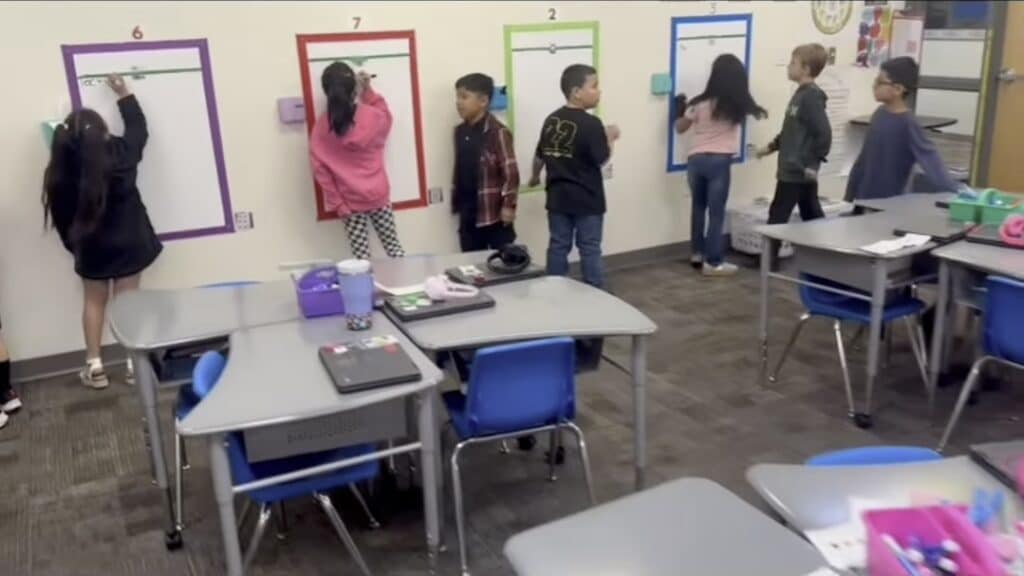
In fall 2021, Meeker Elementary‘s first-grade data meeting ended with a familiar knot in everyone’s stomach: the majority of students were still below benchmark in reading, despite years of “doing all the things.”
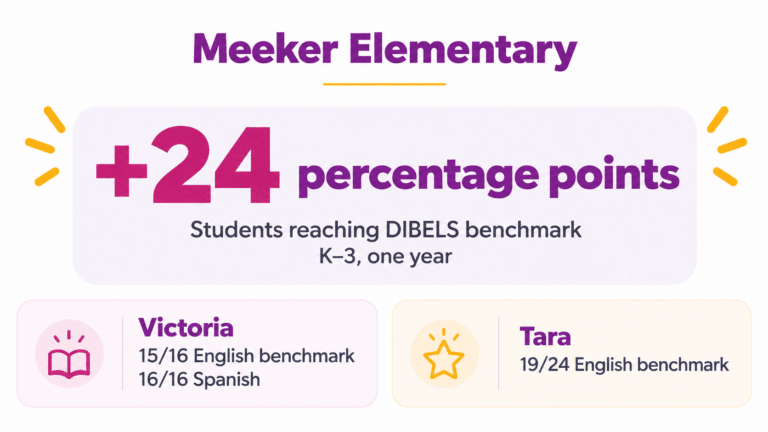
Less than three years later, an independent evaluation from the American Institutes for Research (AIR) documented a 24 percentage-point jump in students reaching benchmark on the DIBELS Composite across Meeker’s K–3 readers in one year.
And now two of the teachers whose classrooms helped drive that shift, Tara Hess and Victoria Ochoa Rodriguez, are Goyen Foundation Literacy Fellows, inviting colleagues inside their structured literacy routines. You’ll find real classroom videos, write-ups, and practical routines you can try tomorrow.
This post is your “front row seat” invitation, because the Goyen Foundation‘s whole point is beautifully simple: teachers need models that show them what to do and how to do it, not just theory.
Why Structured Literacy Routines Matter More Than Ever
Goyen starts with the blunt reality many of us feel in our bones: a large share of U.S. students struggle in reading, and the gaps are devastating.
But their diagnosis has a second layer that matters for adults in the building: teachers are being asked to shift practice—abruptly. And too often the “support” is abstract and disconnected from classrooms. That’s why the Goyen Literacy Fellowship exists: to identify excellent structured literacy teachers, honor them, and share classroom video models so other teachers can actually see what strong practice looks like.
So when you read a Goyen spotlight or watch a Goyen classroom clip, you’re not consuming “content.” You’re borrowing someone else’s hard-won clarity.
Two Teachers, Real Results: Structured Literacy Routines in Action
In the Science of Reading Classroom feature on Reading Simplified, the data points are striking:
Victoria’s dual language kindergarten: 15 of 16 at/above benchmark in English and 16 of 16 at/above benchmark in Spanish by end of year.
Tara’s second grade: 19 of 24 at/above benchmark in English by end of year.
Context matters: the post notes nearly 75% free/reduced lunch eligibility at Meeker.
Those are outcomes. The bigger gift is that Tara and Victoria let us look under the hood at the routines that make outcomes more likely.
The Secret Behind These Structured Literacy Routines: Integrate, Don’t Isolate
One reason these spotlights are so instructive is that they show a key Science of Reading principle in motion: foundational skills grow faster when we stop teaching them like separate jars on a shelf.
Reading Simplified’s approach is built on integration of phonemic awareness, phonics, high-frequency word practice, spelling, and writing, instead of teaching each in its own silo.
If that idea feels almost too ordinary to be revolutionary, here’s the twist: integration changes everything about pace and transfer. You’re not “covering” skills. You’re stacking reps that force the brain to coordinate skills the way real reading demands.
Three Structured Literacy Routines To Study (and Steal)
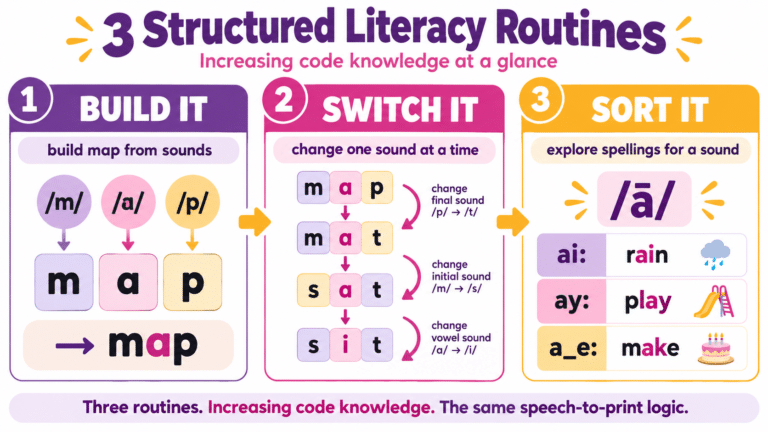
The Goyen feature spotlights three core Word Work routines from Reading Simplified’s lesson framework, and they’re refreshingly concrete: Build It, Switch It, Sort It.
1) Build It: Letter-Sounds Inside Real Words
Build It is exactly what it sounds like: students work with letter-sounds in the context of real words, not as isolated trivia.
Why it matters: beginners do not need more “sound worksheets.” They need connected, meaningful practice that turns sounds into words they can read, say, and keep.
2) Switch It: The Simple Routine That Does Heavy Lifting
Switch It has students change one sound at a time in a word, which quietly exercises multiple skills at once: mapping sounds to letters, segmenting, spelling, and (for older students) handwriting.
This is also where “doing all the things” becomes “doing the right things on purpose.” In one activity, you’re getting dense practice without the lesson sprawling.
And the Meeker story is full of moments where that density mattered. The Reading Simplified case study describes how Tara began using Switch It and, by the end of the year, her intensive group shrank because many students caught up to grade level.
3) Sort It: The Advanced Code, Organized by Sound
English spelling has a lot of patterns. Sort It helps students handle that reality by grouping multiple spellings of the same sound into an organized framework.
Instead of trapping kids in “one sound, one spelling” thinking, Sort It builds flexibility and pattern knowledge. That flexibility is a major difference between “can decode some” and “can keep decoding as text gets harder.”
The Write It Twist: “Running Dictation” as a High-Energy Routine
Want a routine that feels like the classroom got a tiny jolt of electricity (the good kind), while still staying aligned to sound-symbol work and sentence-level writing?
Running Dictation is an efficient partner routine where pairs of students collaborate to write a sentence or short text that’s posted elsewhere in the room. It blends reading, writing, speaking/listening, and teamwork.
If you already use Write It and Write & Say, this can be a smart variation for:
multilingual learners who benefit from repeated oral language + print connection
classrooms that need more purposeful movement
any group that needs sentence-level practice without drifting into “copying” mode
And it harmonizes with a core Reading Simplified principle: spelling, reading, and writing are deeply interconnected, and strengthening one often strengthens the others.
What to Notice When Watching Structured Literacy Routines in Action
If you only watch for “what activity are they doing,” you’ll miss the gold.
Watch for:
Feedback that stays on the sound-symbol work
Not vague praise, not long lectures. Quick prompts that keep the student doing the thinking.
A brisk pace with high success
Not rushed. Not sluggish. Just enough friction to learn, with enough support to win.
Diagnostic teaching in real time
In the Meeker story, a big theme is that teachers gained momentum because the data finally looked different, and the routines felt doable.
That “doable + effective” combination is not accidental. It’s what good routines make possible.
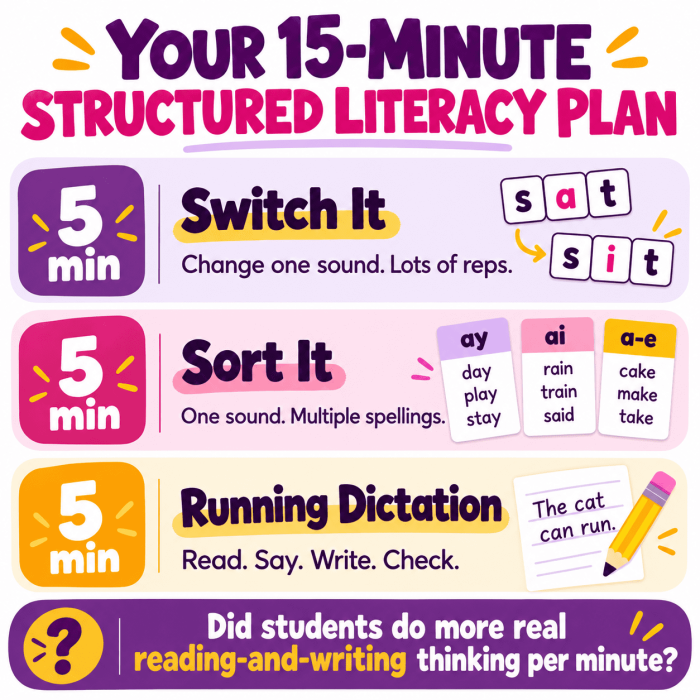
A 15-Minute “Try It Tomorrow” Plan
If you want to test-drive the spirit of these spotlights without reinventing your day:
5 minutes: Switch It (one-sound changes, tight feedback, lots of reps)
5 minutes: Sort It (one sound, multiple spellings, quick read/write sorting)
5 minutes: Running Dictation (one sentence that includes your focus pattern; partners read, say, write, check)
Then ask yourself one simple question: Did students do more real reading-and-writing thinking per minute than usual? If yes, you’re on the scent.
Where to Go Next: Explore More Structured Literacy Routines
If you want the full “see it for yourself” experience, here’s the most logical path:
Start with the Goyen Literacy Fellowship explanation so you understand what you’re watching and why it exists.
Read the Science of Reading Classroom feature that introduces Tara and Victoria and links to their videos and routines.
Then zoom out to the Meeker success story and leadership moves that helped the work spread (and stick).
Finally, if you want the independent outcome snapshot, review the AIR evaluation infographic showing benchmark growth and effect sizes.

Very timely for my work – thank you!
Some gentle feedback: I love the helpful graphics but the cat -> cit example in the switch it graphic is not the best substitution to illustrate?
Ooops! Thanks for catching that Juliet. 🙂 -Marnie